Homeopathy History
Did you know homeopathy once had 22 homeopathic medical schools, more than 100 homeopathic hospitals, over 60 orphan asylums and homes for the elderly, and over 1,000 homeopathic pharmacies in the USA? But, by 1950, there were none. What happened?
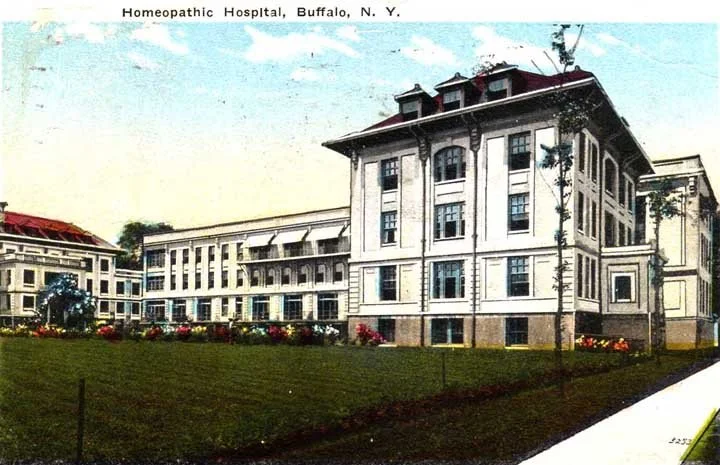
Millard Fillmore Hospital, Buffalo, NY
In 1910, a report was published under the title “Bulletin Number Four,” although everyone came to know it simply as “the Flexner Report.” It was commissioned by the Carnegie Foundation and carried out by a man named Abraham Flexner, an educator with no medical training whatsoever.
Yet this single document reshaped the whole of American medicine. While Carnegie paid for the report, it was the Rockefeller family whose funding carried out its recommendations. Correspondence from Rockefeller's own advisor, Frederick Gates, reveals that these internal communications criticized homeopathy directly, even as they shaped the policy of Rockefeller's philanthropic foundations.
The American Medical Association played its part as well. Researchers have documented a "consultation clause" written into the AMA's code of ethics, forbidding its members from consulting with homeopathic physicians. The AMA also collaborated in writing the Flexner Report itself and used early advertising policies to consolidate its own power and financial resources.
The results were severe. By 1900, homeopathy was taught at 22 medical schools across the country. By 1923, only two remained. By 1950, not a single one was left.
There is a curious irony in all of this. By several accounts, Rockefeller himself preferred homeopathic care throughout his own life, even as the institutions his fortune built went on, after his death, to help erase homeopathy from American medicine.
Thankfully, that isn’t the end of the story. For the last hundred years, maverick homeopaths have carried the torch. The numbers show that now homeopathy is on the rise. New schools and colleges of homeopathic study are opening. A new generation of students is training. Clinics are forming all over the world. And more people are turning to homeopathy every year.
A recent worldwide survey found that fifty-seven percent of people polled across sixteen countries say they have used homeopathy at some point in their lives, and fifty five percent plan to use it again in the future (Toluna, Inc., 2024). The market reflects the same trend. Analysts at Mordor Intelligence valued the global homeopathy product market at over twelve billion dollars in 2025, with growth expected to carry it past sixteen billion dollars by 2031 ("Homeopathy Product Market Size, Share, Trends, Growth (2022-27).")
So why are so many people embracing homeopathy so quickly? What is it about homeopathy that is drawing them in?
That is what we will look at next.
Sources:
Mordor Intelligence, n.d. Homeopathy Product Market Size, Share, Trends, Growth (2022-27). [online] Available at: https://www.mordorintelligence.com.
Psychology Today, 2025. The Medical Monopoly on Mental Health and the Flexner Report. [online] Available at: http://psychologytoday.com/us/blog/the-leading-edge/202502/the-medical-monopoly-on-mental-health-and-the-flexner-report.
Schierling, E., n.d. The Flexner Report and Evidence-Based Medicine. [online] Available at: https://doctorschierling.com/blog/evidence-based-medicine-and-the-flexner-report.
Toluna, Inc., 2024. L'usage de l'homéopathie dans le monde. [online] Toluna. Available at: https://tolunacorporate.com/fr/lusage-de-lhomeopathie-dans-le-monde/.
Ullman, D., n.d. A Condensed History of Homeopathy. [online] Homeopathic.com. Available at: https://homeopathic.com/a-condensed-history-of-homeopathy/.
Ullman, D., 2025. Rockefeller, the Flexner Report, and the American Medical Association: The Contentious Relationship Between Conventional Medicine and Homeopathy in America. Cureus, [online] Available at: https://www.ncbi.nlm.nih.gov/pmc/articles/PMC12318542/.